


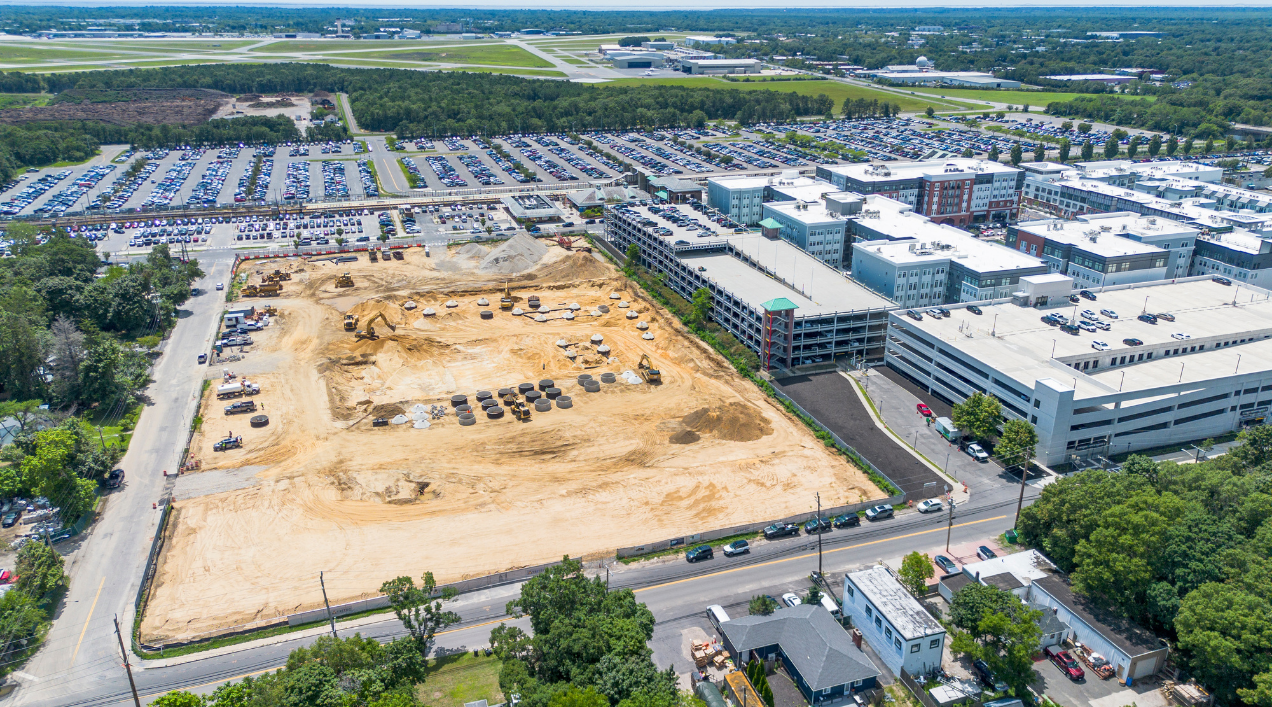

EXCLUSIVE: The Metropolitan Transportation Authority spent nearly $1 million on studies that explored the potential for adding thousands of new housing units at Long Island train stations, LIBN has learned, but the effort has been derailed amid vehement pushback from local elected officials.
The initiative began in Jan. 2024 when the MTA issued a request for proposals for a consultant to “assist the MTA to maximize future development opportunities for housing and mixed-use transit-oriented development around seven stations within MTA’s suburban commuter rail network.”
Five of those stations were Long Island Rail Road stations in Farmingdale, Babylon, Hempstead, Hicksville and Huntington Station, where the consultant was tasked with performing “station area planning to assess the feasibility of multi-story mixed-use residential development,” according to the RFP.
In April 2024, the MTA selected AECOM USA Inc. to perform the consulting work at a cost of $973,310.88, according to the MTA’s task order agreement, and the firm set out to look at MTA-owned parking lots and surrounding properties for possible multifamily housing and the creation of transit-oriented development districts in the five Long Island communities.
When first questioned in Dec. 2025 about the consultant’s work and the study of adding housing at the five LIRR stations, the MTA required LIBN to file a Freedom of Information Law request and delayed any responses for seven months, with the MTA FOIL office repeatedly claiming, “Due to the nature, scope and complexity of the request, an unexpected delay has necessitated an extension of time.”
Finally, at the end of July, the MTA FOIL unit revealed reports presented by AECOM on four train stations, including two in Westchester County (Mount Vernon East and Goldens Bridge) and two on Long Island (Hicksville and Huntington Station). When asked about the other three Long Island stations, the MTA FOIL unit responded that those reports were “non-final records that remain in draft form and are exempted from disclosure.”
Meanwhile, the unpublished MTA studies of Hicksville and Huntington, which were also labeled “working drafts-not for public distribution,” proposed the addition of several hundred housing units at and around those two LIRR stations. The MTA said the TOD studies were born out of Gov. Kathy Hochul’s Executive Order 30, which directed state agencies to review parcels under their ownership or control to identify potential sites for housing development. But when AECOM and MTA representatives began speaking with local elected officials and their planning staff, those development hopes went off the rails.
In its Hicksville study, the MTA suggested that at least 516 more apartments and about 37,000 square feet of retail could be built “as-of-right” on Town of Oyster Bay-owned parking lots just north and east of the train station, while recommending the MTA could build two new parking garages on the northwest side of the station to make up for the 1,747 vehicle spaces that would be lost to the new development.
The town has already facilitated more than 530 new apartments completed or in development around the Hicksville LIRR station as a result of the town’s downtown zoning and in concert with the $10 million Downtown Revitalization Initiative (DRI) grant it received from the state in 2017. The MTA study called the town’s planning efforts a “positive sign,” but pointed out unless density is championed at the municipal level, as in places like White Plains and New Rochelle, “home-rule communities” will continue to reject higher levels of housing density.
Oyster Bay Supervisor Joseph Saladino, who was not pleased by the MTA’s effort, said the public doesn’t want developments shoved down their throat. “They want to do developments where they can be collaborators, and they can play an important role, and that’s just what we did with the DRI process,” Saladino told LIBN. “When you take away zoning powers, it clearly shows that the state knows the public doesn’t want high-rise, high-density apartment buildings, so they take away people’s right to be heard. They want to do just what they want to do. They’re trying to backdoor it.”
The MTA’s “Summary Development Program” for Huntington Station proposed 10 new residential buildings (seven three-story, two four-story and one five-story) on 2.35 acres of MTA-owned parking lots on the south side of the tracks and 3.96 acres of parking lots owned by New York State Department of Transportation along New York Avenue.
The Huntington Station study also suggested a new 1,000-spot parking garage be built on Railroad Street just west of New York Avenue to make up for lost surface parking that would be taken up by some 450 new housing units.
The Town of Huntington received the state’s $10 million DRI grant in 2022, and in its market analysis of the area, the MTA study found that the town was supportive of new development around the station. The study also claims that RXR and Renaissance Downtowns have right of first refusal to develop most of the publicly owned lots and have proposed projects over the past five years, “though plans have stagnated in negotiations with state agencies over land value.”
Huntington Town Supervisor Ed Smyth called the MTA study misguided.
“Clearly the MTA study goes outside property under their ownership and control,” Smyth told LIBN. “We’ve taken positive steps to address housing in Huntington and did it through a local process. This is a top-down mandate. Local municipalities don’t want bureaucrats in Albany to dictate fiscal policies and land use.”
While the MTA studies of Babylon, Farmingdale and Hempstead were withheld from LIBN’s FOIL request, the elected officials of those communities said they had little room for more housing.
“I told them ‘Not here,’” said Babylon Mayor Mary Adams. “The MTA lot has about 100 spots and it’s not very big. There would be problems with density.”
Adams said AECOM and the MTA did their study and walked away.
“They were no longer interested, and that’s a good thing,” she said. “I don’t know how much more this island can hold. I am a real estate broker by trade and I understand the need for housing and all of that, but come on.”
Sedgwick Easley, director of publicity for the Village of Hempstead, said that there are already several hundred units of new housing recently built and under development over the past few years. He added that Hempstead, which received the state’s $10 million DRI grant last year, is in the midst of its downtown revitalization, though Easley didn’t comment specifically about the MTA’s study.
In Farmingdale, where Mayor Ralph Ekstrand has approved the development of 550 new apartments over the past several years, the reception to more multifamily housing on the MTA-owned parking lot on the north side of the village’s LIRR station was chilly.
“I fought it vehemently,” Ekstrand told LIBN. “They went and spent $3 billion to put in the second track, and now you want to take away 300 spots and build a five-story, low-income apartment building. How does that help my transit-oriented development? They walked away from Farmingdale, guaranteed hands down.”
When asked to comment about the pushback from local elected officials on the proposals in its draft studies, MTA spokesman Lucas Bejarano said: “The documents in question were preliminary reports and there are no plans to pursue further action at this time.”
The MTA has collaborated with Long Island municipalities on new housing development around LIRR stations over the past dozen years. In 2014, the MTA swapped property with the Town of Babylon and built a new parking garage to make room for the Wyandanch Village project.
In Westbury, the MTA built a $23 million, three-and-a-half story parking structure on village land leased to the MTA as part of its Third Track project. The new garage freed up its south parking lot for development, where Gotham Organization has proposed to build a five-story, mixed-use building to bring 184 apartments over 15,000 square feet of ground-level retail space on 1.92 acres on Railroad Avenue leased from the MTA.
In Ronkonkoma, Tritec Real Estate has had discussions with the MTA about building some of its Station Yards mixed-use development on the MTA-owned parking lots on the north side of the LIRR station, though a deal has yet to be reached.
Eric Alexander, director of Vision Long Island, which has worked on planning efforts around several LIRR stations, including Hicksville, Huntington Station, Farmingdale, Westbury and others, said there is a need for additional affordable and market-rate multifamily housing plans around LIRR stations.
“For these plans to become successful, collaboration is needed with the local municipality, civic and business leaders through a transparent process with local governments holding clear land use authority,” Alexander told LIBN, citing the Westbury example as collaborative and transparent planning. “The larger state or regional agency should incorporate their ideas into existing land use and hamlet plans, particularly with communities who have been successful at redevelopment, as opposed to creating their own in a vacuum.”