



New York is the most expensive city in the U.S.
Here, the cost of living is 131.7% higher than the national average, and the average rent is 147% higher than the national average. What’s more, New York City rentals are significantly smaller despite the higher price tag—the average size of a 1-bedroom apartment is 591 square feet, 15% smaller than the national average of 696 square feet.
New York City saw tens of thousands of residents move out during the COVID-19 pandemic in 2020 and 2021, and while the city’s population increased in 2023 and 2024, many renters are disillusioned to the city’s housing market. With prices already sky-high, rising rents are driving many renters out of the city and into neighboring suburbs.
The Rental Pressure Inside NYC
The combination of high development costs, slowing construction, and the allure of living in New York City has created a pressure cooker of a rental market where supply can’t keep up with demand.
High operating costs set high rents
New York real estate is a hot commodity, and the demand drives up prices all around. Real estate is expensive, so property managers have to keep prices high to cover operating costs.
Tax exemptions influence construction
The high price of real estate poses a barrier to entry for development, and a lack of incentives are slowing down construction.
New York State’s previous tax exemption program for affordable housing expired in 2022, and developers are racing to finish projects approved for the exemption before the deadline—now June 2031, after Governor Kathy Hochul extended it from June 2026.
In its place is what developers view as a weaker alternative, with stricter requirements that make developments less feasible. CoStar Group reports that the weaknesses in the new tax exemption program have resulted in stalled projects.
High demand pushes prices upward
The vacancy rate in New York City is currently 3.4%, almost half the national rate of 8.3%. Vacancy rates in New York City haven’t surpassed 4% since 2009, reflecting the ever-rising demand for rentals in the Big Apple and construction that can’t keep up.
An NYC exodus
The Fiscal Policy Institute reports that New York City is the source of 90% of the state’s population loss, and this out-migration is largely driven by the city’s declining affordability. The rental pressure in the city is pricing out many New Yorkers, and The New York Times cites housing and childcare costs as the culprits.
However, because New York City still has a booming job market, many New Yorkers are moving to nearby suburbs where they can find more affordable housing and still commute to their jobs in the city.
An industry professional says the out-migration comes with a lifestyle shift: “[Ex-New Yorkers] are still trying to find similar situations where they can work, live, play.”
Why Suburbs Are Gaining Appeal
Property managers are following renters to the suburbs, too. Over 10,000 new units were delivered in neighborhoods outside the city between January and September of this year, according to CoStar Group data. Increased construction in NYC-adjacent suburbs signals that developers view these areas as a lasting opportunity.
Here are a few key reasons why New Yorkers are flocking to the suburbs.
They’re cheaper
Cost is the primary factor behind the migration to the suburbs. With rent prices in New York already one and a half times the national average and continuing an upward trend, many New Yorkers are being priced out of the city.
Rentals in nearby suburbs—particularly in New Jersey, Long Island, and the Mid-Hudson region—are significantly cheaper than those within NYC while still putting residents close to the action.
There’s more space
Another main driver behind renters moving to the suburbs is that renters can get more for less. Rentals outside the city typically offer more square footage, more privacy, and more outdoor amenities like a backyard or community courtyard.
In addition to the bigger rental sizes, suburbs outside of the Big Apple are less densely developed. Between the smaller population and less active job market, commuter suburbs give residents more breathing room.
They’re quieter
New York is known as “the city that never sleeps” for a reason; the subway is always running, the lights are always shining, and there’s always something exciting happening.
While this energy is appealing to some, many renters are getting tired of the constant noise. Nearby suburbs have become a landing pad for NYC migrants searching for some peace and quiet.
Commute times can be comparable to those in NYC
Suburban renters often find that the commute to Manhattan from outside the city doesn’t take much longer than commutes from the other boroughs.
In areas farthest from Manhattan, like Flatbush in Brooklyn or East Bronx in the Bronx, subway commutes to Midtown Manhattan can take upwards of an hour. Meanwhile, travel times from some commuter towns in Westchester County in New York and Essex County in New Jersey are often shorter.
How Suburbs Are Responding
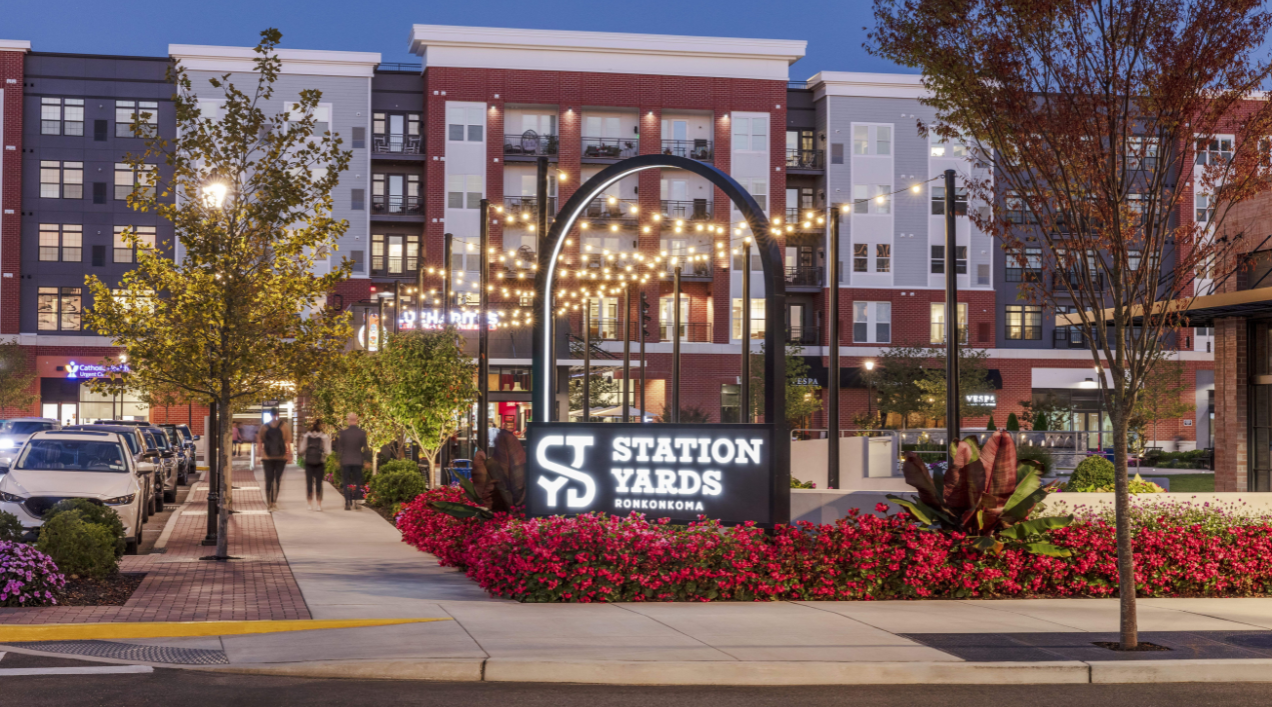
Station Yards in Ronkonkoma, NY, is a “lifestyle hub” right next to the Long Island Rail Road Ronkonkoma station. (Photo by Alan Schindler for Niles Bolton Associates and TRITEC Real Estate Company)
Suburbs in surrounding areas are delivering more rentals in response to this increased demand. Developers are finding ways to compete in these rising rental markets with revitalized downtowns and lifestyle communities.
One such community is the Station Yards development in Ronkonkoma, a suburb at the center of Long Island. Previously known as Ronkonkoma Hub, TRITEC Real Estate Company reimagined the development as a housing-retail-office project. Station Yards opened in 2019 after seven years of development planning.
“We wanted it to be authentically Long Island.”
Chris Kelly, senior vice president for TRITEC Real Estate Company
However, the majority of Suffolk County doesn’t have a public sewage system, which has been an obstacle in creating more housing on Long Island. Chris Kelly, senior vice president of marketing for TRITEC, says the company had to develop Station Yards from the ground up because of the lack of sewage.
“We added 1.5 million gallons of sewer capacity in Ronkonkoma. Our project, at completion, will use about 450,000 gallons, so it actually opens up for a lot more economic development in the surrounding area,” says Kelly.
Station Yards’ location next door to the Long Island Rail Road Ronkonkoma station makes it ideal for commuters, but the vision behind the community wasn’t to make Station Yards an extension of Manhattan.
“It was an opportunity to create something that was happening in other parts of the country, but not on Long Island,” says Kelly.
The Station Yards development reflects a larger effort among commuter towns to transform from bedroom communities to a place that offers something unique. Most of the retailers at Station Yards are Long Island-based brands, creating a destination in a previously underutilized area.
“There’s nothing wrong with [national brands],” says Kelly, “but it could be in Idaho, or it could be in Wisconsin or New York. We saw this as a different kind of development than Long Island’s used to, so we wanted it to be authentically Long Island.”
Read the full article in Apartments.com.